


.svg)

What Is Agentic Exposure Management?
Agentic Exposure Management is an operational approach to cybersecurity where autonomous AI-driven agents continuously identify, prioritize, and remediate security exposures across an organization’s environment without relying on manual coordination.
Traditional vulnerability management focuses on identifying and tracking vulnerabilities. Agentic exposure management extends beyond identification into action. It replaces fragmented workflows with systems that can make decisions and execute remediation steps in real time.
At its core, this model introduces AI security agents that:
- Continuously analyze security data from across the environment
- Determine which exposures matter based on context and risk
- Initiate and track remediation actions without requiring human intervention
This creates a continuous cycle of exposure discovery, prioritization, and resolution. Instead of producing lists of issues for teams to address, agentic systems actively reduce risk by closing the loop.
Why Traditional Vulnerability Management Is No Longer Enough
Legacy vulnerability management programs were designed for relatively static environments. They struggle to keep up with the scale and dynamism of modern attack surfaces.
More critically, they lack the context and operational mechanisms required to reduce risk in today’s conditions:
- Lack of compensating controls context: Traditional programs treat vulnerabilities in isolation, without accounting for existing controls that may already mitigate exploitability. This leads to inflated risk perception and wasted remediation effort.
- Lack of cloud-native guardrails and policies: Modern environments rely on dynamic controls such as IAM policies, runtime protections, and infrastructure-as-code guardrails. Legacy approaches do not incorporate these into prioritization or remediation decisions.
- Drastic increase in AI-discovered 0-days: AI-operated security researchers and adversaries are accelerating vulnerability discovery. The volume and velocity of new exploitable vulnerabilities are increasing beyond what manual processes can handle.
- Shrinking Time-to-Exploit (TTE): TTE is now often less than 24 hours. Organizations must detect, validate, prioritize, and resolve vulnerabilities within a single day to meaningfully reduce risk. Most current programs are not designed for this speed.
At the same time, today’s environments include:
- Cloud infrastructure that changes continuously
- SaaS applications with limited visibility
- APIs and microservices expanding the attack surface
- Complex identity and access relationships
This complexity has led to systemic challenges.
First, alert fatigue. Security tools generate more findings than teams can realistically triage. Even with vulnerability prioritization techniques, most organizations accumulate growing backlogs.
Second, tool sprawl. Organizations rely on multiple scanners and platforms for cloud, application, and infrastructure security. Each tool produces its own data set, making unified analysis difficult.
Third, remediation bottlenecks. Even when risks are identified, resolving them requires coordination across security, engineering, and operations teams. This slows down response times and leaves exposures open.
Frameworks like Continuous Threat Exposure Management (CTEM) emphasize continuous prioritization, but they stop short of execution. As a result, many organizations can identify risk but struggle to reduce it at scale.
How Agentic Exposure Management Works
Agentic exposure management introduces an operational layer that connects discovery, prioritization, and remediation into a continuous system.
Continuous Exposure Discovery
Agentic systems continuously identify exposures across infrastructure, applications, cloud assets, and identities.
They aggregate signals from:
- Vulnerability scanners
- Cloud security platforms
- Application security tools
- Identity and access management systems
This creates a unified exposure view, similar to what platforms offering unified vulnerability management aim to achieve. However, instead of just consolidating data, agentic systems actively use it to drive decisions.
Contextual Risk Prioritization
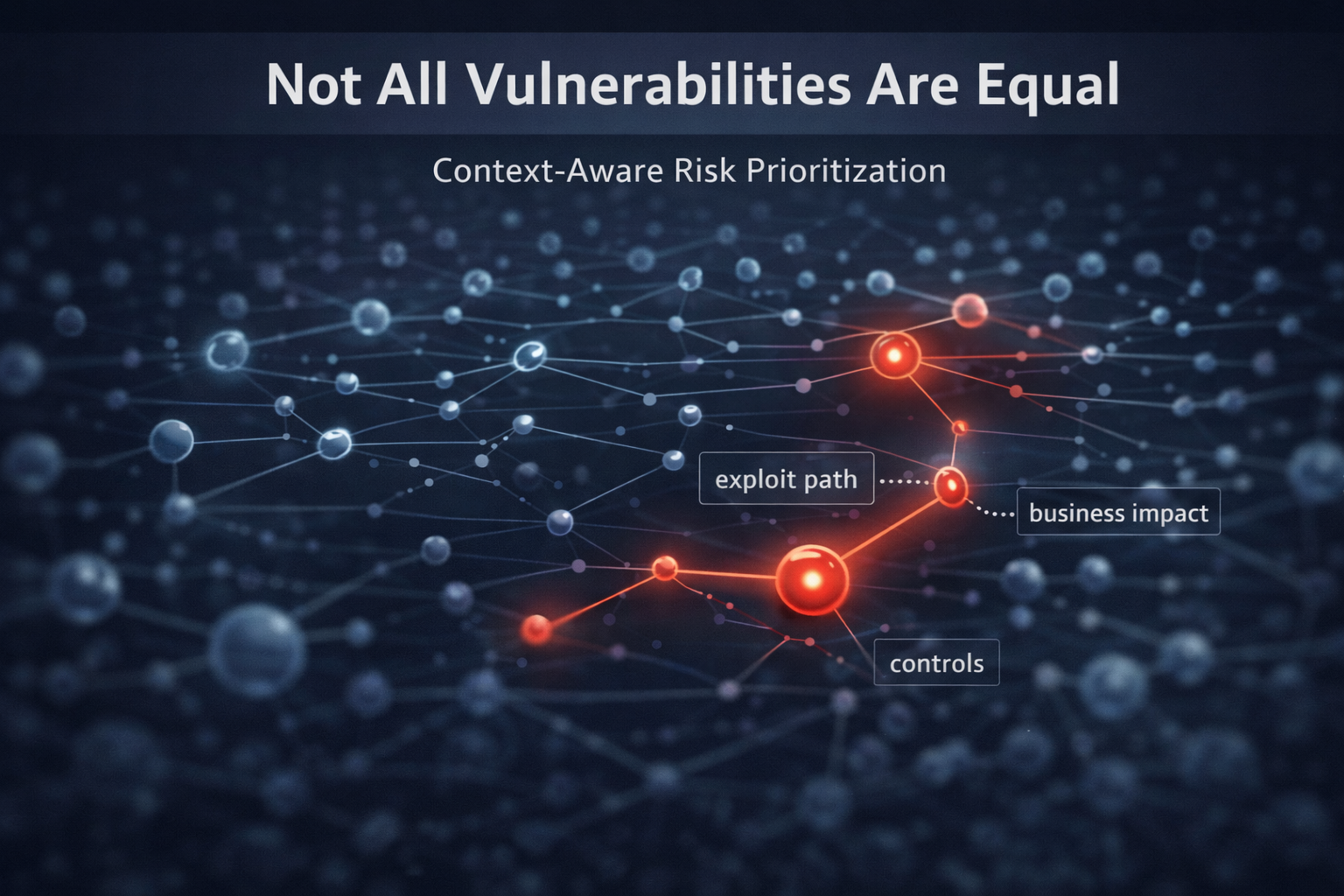
Not all exposures are equal. Agentic systems correlate vulnerabilities, misconfigurations, and identity risks to understand how they interact.
They evaluate:
- Real-world exploitability using models aligned with frameworks like MITRE ATT&CK
- Business impact based on asset criticality
- Attack paths that combine multiple weaknesses
This produces context-aware prioritization, enabling risk based vulnerability management that focuses on what can actually be exploited, not just what is theoretically vulnerable.
Autonomous Remediation Workflows
Once risks are prioritized, agents initiate remediation workflows.
Instead of creating tickets and waiting for teams to act, they:
- Trigger configuration changes
- Open and track pull requests
- Coordinate fixes across systems
- Validate dependencies before taking action
This replaces manual vulnerability remediation workflows with automated orchestration. Platforms focused on exposure mitigation demonstrate how these workflows can be executed across complex environments.
Closed-Loop Risk Reduction
Agentic systems continuously verify whether exposures have been resolved.
They:
- Re-scan affected assets
- Confirm that remediation actions were successful
- Reassess risk posture after changes
This creates measurable cyber risk reduction, moving security programs from tracking issues to achieving outcomes. The focus shifts from identifying exposures to delivering continuous risk resolution.
Agentic Exposure Management vs Traditional Exposure Management
The key shift is operational. Traditional approaches produce insights. Agentic systems produce outcomes.
By automating analysis and remediation, organizations move from reactive security toward continuous, measurable risk reduction.
The Role of AI and Autonomous Agents in Exposure Management
In this context, security agents are software entities that can independently perform tasks such as analyzing data, making decisions, and executing actions.
AI enables these agents to:
- Correlate large volumes of security data
- Identify patterns and attack paths
- Make risk-based decisions without predefined rules
These agents integrate with existing security tools rather than replacing them. They consume data from cloud security, application security, and infrastructure platforms, then act across those systems.
For example:
- In cloud security, agents can remediate misconfigurations directly in cloud environments
- In application security, they can initiate fixes in code repositories
This approach reduces operational overhead by eliminating repetitive tasks such as triage, ticket creation, and cross-team coordination.
Benefits of Agentic Exposure Management
Faster Exposure Resolution
By automating the path from discovery to remediation, agentic systems significantly reduce the time exposures remain open.
Gain Control over the Vulnerability Backlog
Agentic systems introduce autonomous exploitability analysis that continuously evaluates whether a vulnerability is actually exploitable within a specific environment.
Instead of treating every CVE as actionable, agents:
- Analyze runtime context, network exposure, and compensating controls
- Determine whether an exploit path exists in the real environment
- Suppress or deprioritize findings that cannot be exploited
This allows organizations to eliminate large portions of their backlog that do not represent real risk, focusing only on exposures that require action. Over time, this transforms backlog management from an accumulation problem into a controlled, continuously optimized process.
Catch Up with AI-Driven Attacks
Threat actors are already using AI to accelerate vulnerability discovery and exploitation. This includes identifying new 0-days and weaponizing them at a speed not previously possible.
To match this velocity, defenders must adopt the same paradigm.
Agentic systems enable:
- Rapid analysis of newly disclosed vulnerabilities
- Immediate validation of exploitability within the environment
- Automated initiation of remediation workflows
This allows security teams to operate at machine speed, aligning defensive capabilities with the pace of AI-driven attacks rather than falling behind them.
Improved Risk Prioritization
Context-aware analysis ensures that teams focus on exposures that have real-world impact, improving overall security exposure management.
Better Alignment Between Security and Engineering
Automation bridges the gap between teams by embedding remediation into existing workflows, reducing friction and delays.
Reduce exposure faster with automated risk resolution.
Zest Security helps security teams identify, prioritize, and remediate exposures across cloud, applications, and infrastructure through a unified exposure management platform.
How Agentic Exposure Management Supports Modern Security Frameworks
Agentic exposure management aligns closely with modern security strategies and frameworks.
Continuous Threat Exposure Management (CTEM) emphasizes continuous identification and prioritization of exposures. Agentic systems extend this by executing remediation, completing the cycle CTEM defines.
Risk-based vulnerability management is enhanced through contextual analysis and automated decision-making, ensuring that prioritization leads to action.
Cloud-native security practices benefit from continuous monitoring and automated remediation across dynamic environments, supporting scalable cloud exposure management.
DevSecOps initiatives are strengthened by embedding security remediation directly into development workflows, enabling continuous security automation.
This evolution also reflects a broader shift toward proactive models such as preemptive exposure management, where organizations aim to reduce risk before it can be exploited.
The Future of Exposure Management
Security operations are moving toward AI-driven systems that can operate at machine speed.
As environments become more complex and attack surfaces expand, manual processes will become increasingly unsustainable. Agentic systems will become foundational, not optional.
Over the next few years, exposure management platforms are expected to:
- Shift from dashboards to autonomous execution
- Integrate more deeply with engineering workflows
- Provide continuous validation of security posture
The emphasis will move from visibility to action, and from prioritization to resolution.
Final Thoughts
Agentic exposure management represents the next evolution of exposure management.
CTEM defines what organizations should prioritize. Unified vulnerability management brings data together. Agentic systems complete the model by acting on that data and continuously reducing risk.
For organizations managing modern attack surfaces, automation and AI are no longer enhancements. They are requirements for achieving consistent, scalable cyber risk reduction.
Agentic exposure management is redefining how security teams manage cyber risk. Instead of relying on manual workflows and disconnected tools, modern organizations are turning to automated platforms that continuously identify and resolve exposures.
Learn how Zest Security helps security teams reduce risk through unified exposure management and automated remediation.
About The Author

.jpg)