


The Mythos Readiness Report
AI made finding vulnerabilities cheap. This report measures what it takes to validate, mitigate and remediate them before attackers do, across 77 million vulnerabilities in ZEST customer environments.





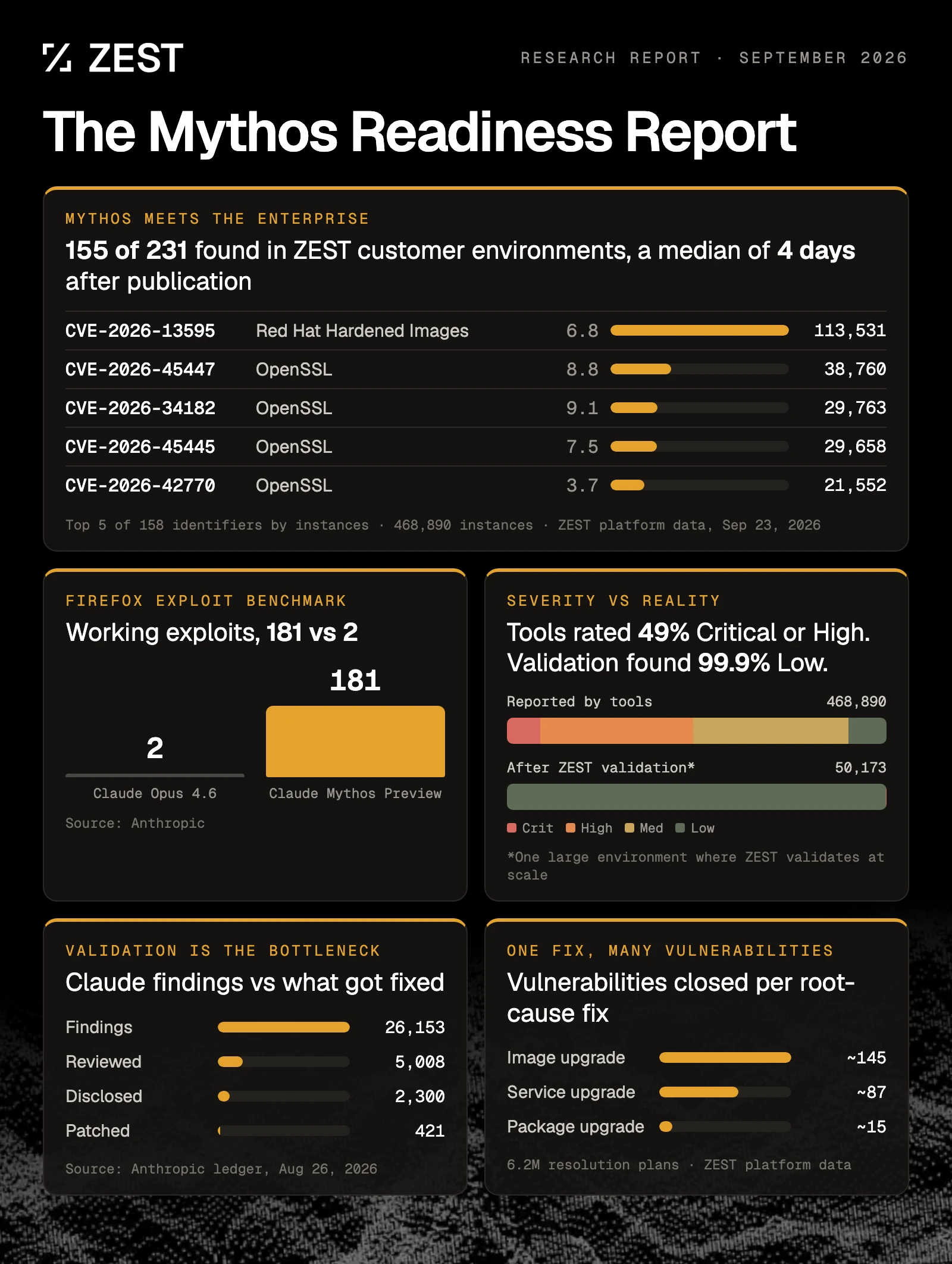
Finding vulnerabilities isn't the hard part anymore
Security teams already know about more vulnerabilities than they can close, and in 2026 the tools that find them got much better. Anthropic's Claude Mythos Preview showed that a frontier model can find serious flaws in mature open-source code and turn a known bug into a working exploit in less than a day.
As discovery becomes abundant, the hard part moves to what happens next: proving which vulnerabilities are exploitable in your environment and closing them before an attacker does. That is the work ZEST does every day, and this report combines our platform data with public research to show what readiness for machine-speed discovery takes.
Four findings that reset the priorities
Are you ready for the Mythos era?
AI can now turn a known vulnerability into a working exploit in less than a day. Readiness means validating, mitigating and fixing at the same machine speed, with evidence behind every decision.
Validate at machine speed
ZEST unifies the vulnerabilities your entire security stack reports. Its AI agents validate exposure, reachability and exploitability in your environment and dismiss what attackers can't exploit.
Mitigate with the controls you already run
ZEST Preemptive Mitigation validates the protection your existing controls provide, from zero trust access policies to WAF rules and cloud guardrails, and marks the vulnerabilities they protect against as Mitigated.
Remediate at the root cause, automatically
Automated Remediation traces exposures to their root cause, so one fix removes many of them. AI agents simulate it on a Digital Twin of your cloud and on-prem environments, apply it through your deployment system and close it only after a rescan confirms the fix.
Agentic exposure management and remediation
ZEST Security closes the gap between the vulnerabilities an organization's tools report and the risk it carries. The platform validates exploitability and reachability, dismisses what cannot be exploited with evidence, marks what existing controls protect against as Mitigated, and uses AI agents and Digital Twin simulation to remediate the rest at the root cause.