



This is a developing story. We will update this post as distributions ship fixed packages and as exploitation details change. Last updated November 19, 2026, 12:45 UTC.
TL;DR
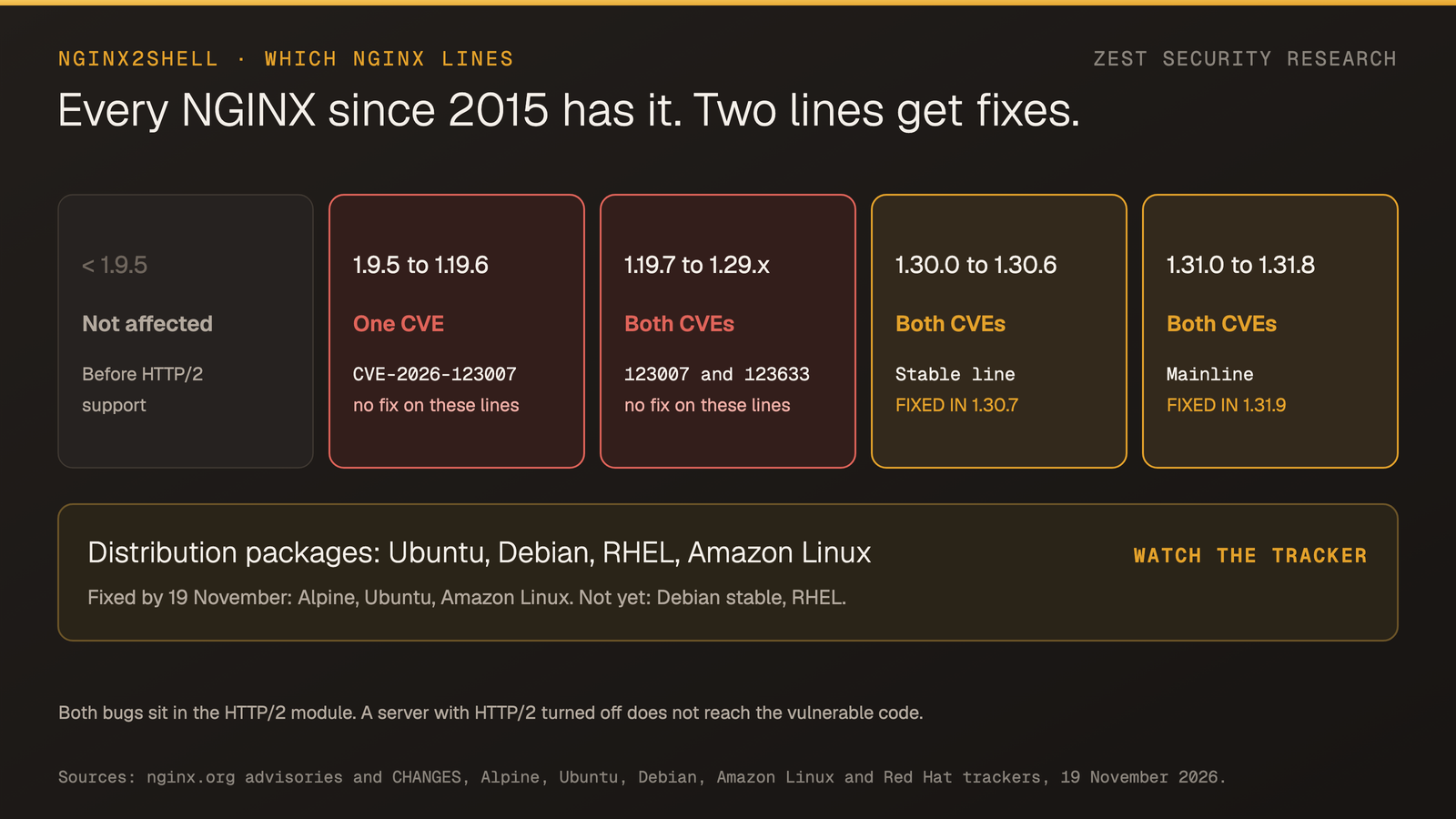
- Fixed in NGINX 1.30.7 (stable) and 1.31.9 (mainline), released 18 November 2026. CVE-2026-123007 affects 1.9.5 to 1.31.8; CVE-2026-123633 affects 1.19.7 to 1.31.8.
- Both bugs live in the HTTP/2 code. A server that has HTTP/2 turned off does not reach them, which makes turning it off the fastest mitigation.
- Wiz reports unauthenticated code execution for CVE-2026-123007 against official NGINX builds serving ordinary static files, with no backend and no third-party module.
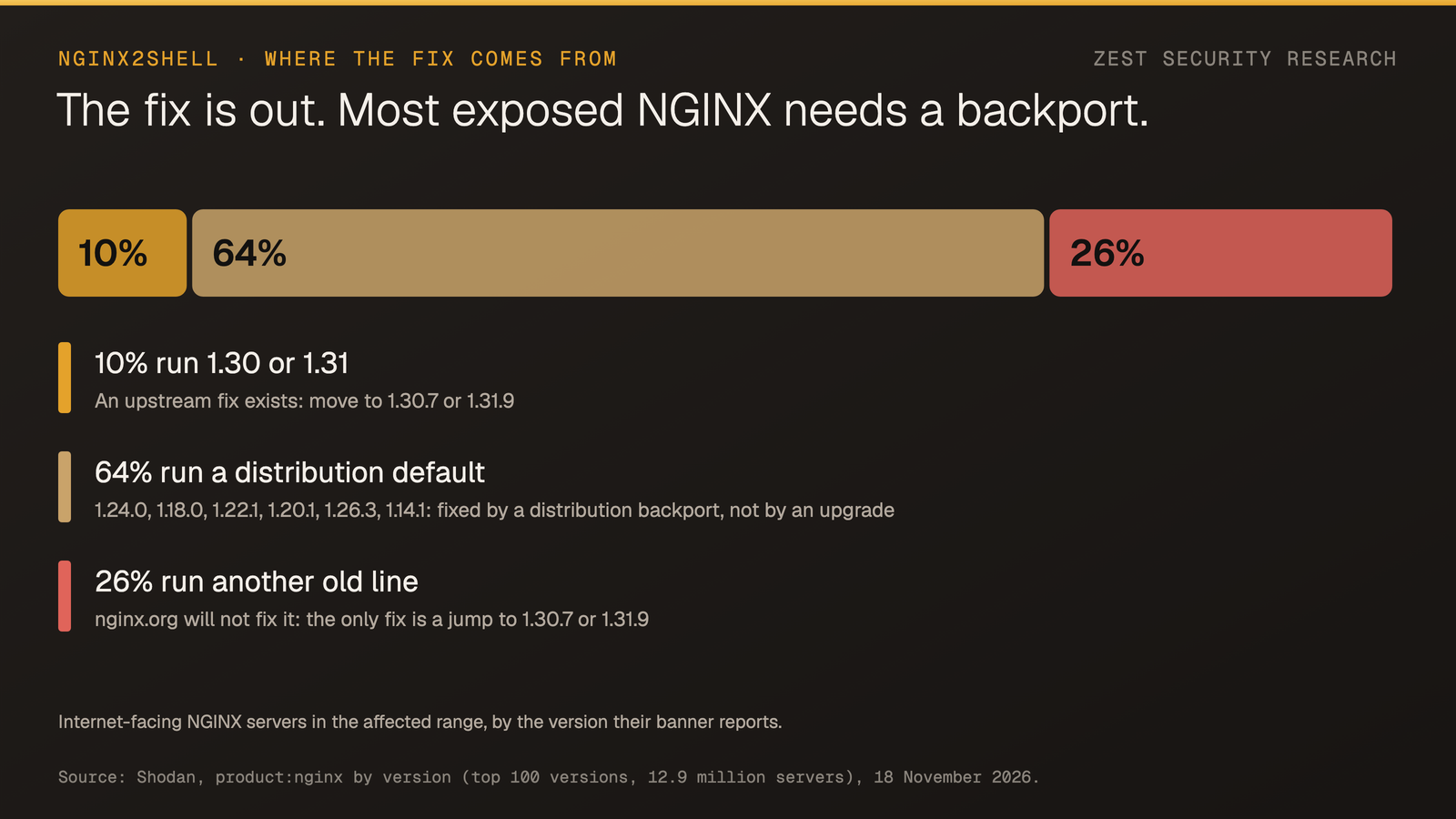
- Most NGINX on the internet gets its fix from a distribution, not from nginx.org. Of the internet-facing NGINX servers in the affected range whose version Shodan reports, only 10% run 1.30 or 1.31. 64% report a version that Ubuntu, Debian or RHEL ships by default, so their fix is a backported package: Ubuntu and Amazon Linux have shipped one, Debian stable and RHEL have not yet. 26% run another old line that nginx.org will never fix.
- No exploitation in the wild had been reported as of 12:20 UTC on November 19, and neither CVE is on CISA's KEV list. Rapid7 has shown code execution in a lab with its own proof of concept.
On November 18, NGINX shipped 1.30.7 and 1.31.9 with fixes for a batch of memory-safety bugs. Two of them sit in the HTTP/2 implementation, which many TLS deployments turn on. CVE-2026-123007 is memory corruption in HTTP/2 flow control and affects every release from 1.9.5, the first version with HTTP/2, in September 2015. CVE-2026-123633 is a use-after-free in HTTP/2 that affects 1.19.7 and later. We track the pair as NGINX2Shell.
Wiz says five teams found these bugs independently: Wiz Research, Ikotas Labs, Metnir, Rapid7 and Xint. Wiz found its share with AI models running in its own testing harness. When five teams find the same bugs, assume people who do not publish found them too.
NGINX2Shell status: what is confirmed
Confirmed
- Two NGINX HTTP/2 bugs: CVE-2026-123007, memory corruption in HTTP/2 flow control (nginx severity major, vulnerable 1.9.5 to 1.31.8), and CVE-2026-123633, a use-after-free in HTTP/2 when worker_connections run short (nginx severity medium, vulnerable 1.19.7 to 1.31.8). Both need HTTP/2 enabled. (source)
- F5 scores both CVSS 4.0 9.2 (Critical) and CVSS 3.1 8.1 (High). (source)
- Fixed in NGINX 1.30.7 (stable) and 1.31.9 (mainline), released 18 November 2026. CVE-2026-123007 affects 1.9.5 to 1.31.8; CVE-2026-123633 affects 1.19.7 to 1.31.8. (source)
- Alpine fixed both CVEs in nginx 1.30.7-r0 (edge and 3.24). (source)
- Ubuntu released fixed nginx packages for every release from 16.04 to 26.10 (USN-9159-1); 16.04, 18.04 and 20.04 get them through Ubuntu Pro. (source)
- Amazon Linux fixed nginx on Amazon Linux 2023 (ALAS2023-2026-3494) and the AL2027 preview on November 18, and on Amazon Linux 2 (nginx1 extra, ALAS2NGINX1-2026-018) on November 19. (source)
- Debian fixed nginx in unstable (1.30.6-4). Bookworm (1.22.1-9+deb12u10), trixie (1.26.3-3+deb13u10) and forky (1.30.6-3) are still listed as vulnerable (2026-11-19 12:20 UTC). (source)
- Red Hat rates both CVEs Critical and lists nginx on RHEL 8, 9 and 10 as affected, with no fixed package yet (2026-11-19 12:20 UTC). (source)
- Neither CVE is in the CISA KEV catalog as of catalog version 2026.11.18 (checked 2026-11-19 12:20 UTC). CISA's SSVC entry lists exploitation as none. (source)
- Rapid7 demonstrated unauthenticated code execution through CVE-2026-123007 with its own proof of concept against NGINX 1.31.8 in a lab. Its exploit needed about 128 GB of HTTP/2 traffic, which Rapid7 says limits attacks over the internet. (source)
Reported
- No public report of exploitation in the wild as of 2026-11-19 12:20 UTC. CISA SSVC lists exploitation: none. (source)
- Xint reports a separate Linux kernel bug that can be chained with any of these NGINX bugs to gain root on the host, and calls the set NGINX2Root. (source)
The ratings disagree. nginx.org rates CVE-2026-123007 major and CVE-2026-123633 medium. F5, which owns NGINX, scores both 9.2 (Critical) under CVSS 4.0 and 8.1 (High) under CVSS 3.1, with high attack complexity.
How the NGINX2Shell bugs work
HTTP/2 multiplexes many streams over one connection, and flow control decides how much data each side may send before the other side grants more room. In CVE-2026-123007, NGINX mishandles the window arithmetic. nginx.org says an overflow of the flow control window "might allow an attacker to cause a segmentation fault in a worker process, or might have potential other impact". Wiz shows what that other impact is: code execution on official 1.31.7 and 1.31.8 builds over HTTP/2 with TLS on 64-bit systems, with an ASLR bypass. Wiz adds that either bug can leak memory before the code execution step, so ASLR alone does not stop it.
CVE-2026-123633 is narrower. The use-after-free happens in a worker process when NGINX runs short of worker_connections, and Wiz says it is more likely to be reachable when NGINX proxies to a backend.
Wiz is not releasing its exploits, and F5 says only the data plane is affected.
Who is exposed to NGINX2Shell
A server is exposed when it runs an affected version and accepts HTTP/2. On NGINX, HTTP/2 is opt-in per server, and it is common on TLS sites because browsers load pages faster over it. CDNs and WAFs that terminate HTTP/2 in front of NGINX may block parts of the attack, Wiz says, so a server behind one is lower priority than one facing the internet directly, not safe.
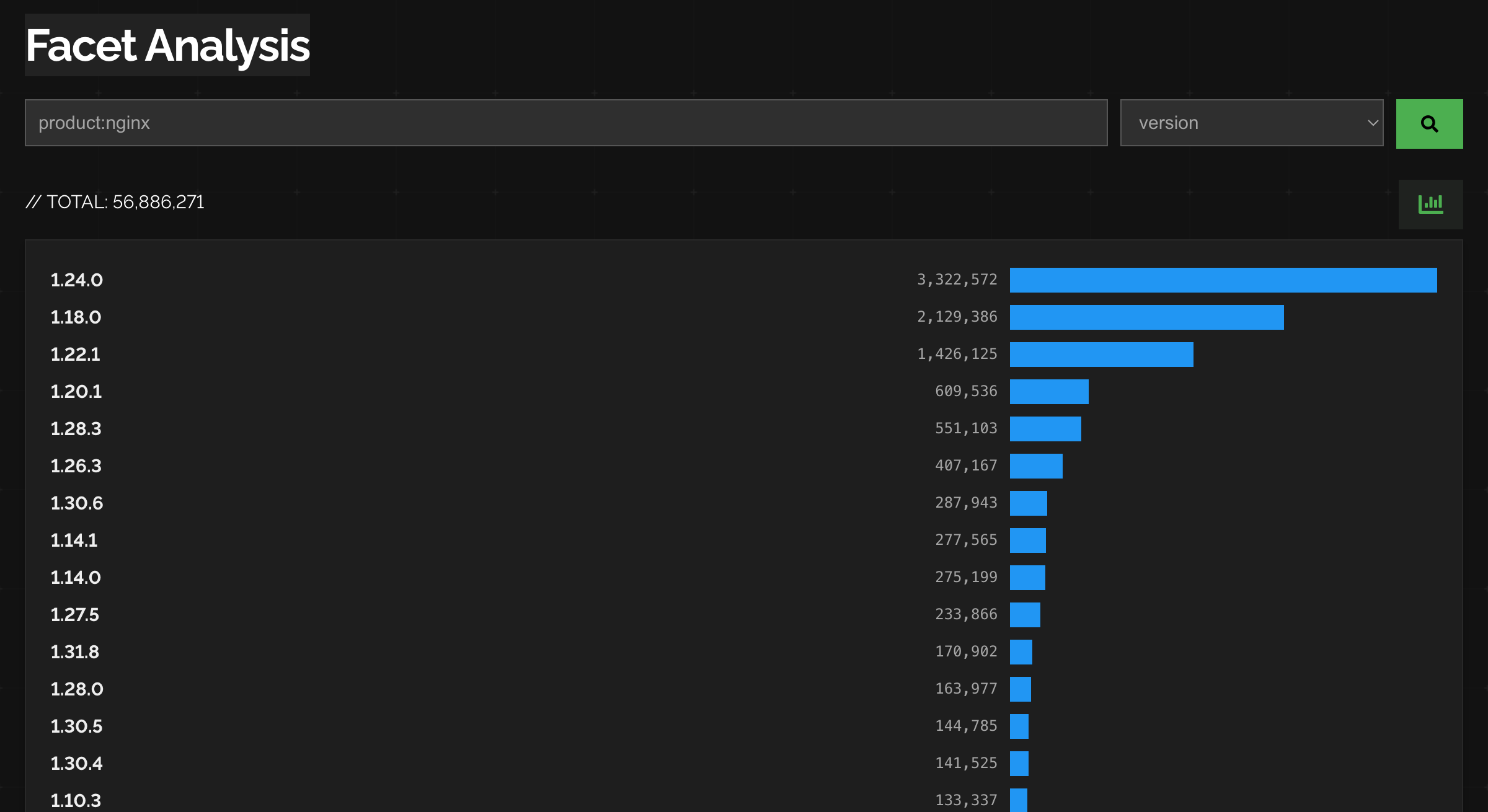
Wiz counts more than 225 million websites on NGINX. On November 18, Shodan fingerprinted about 56.9 million NGINX servers, and the four most common versions it sees, 1.24.0, 1.18.0, 1.22.1 and 1.20.1, are all inside the affected range.
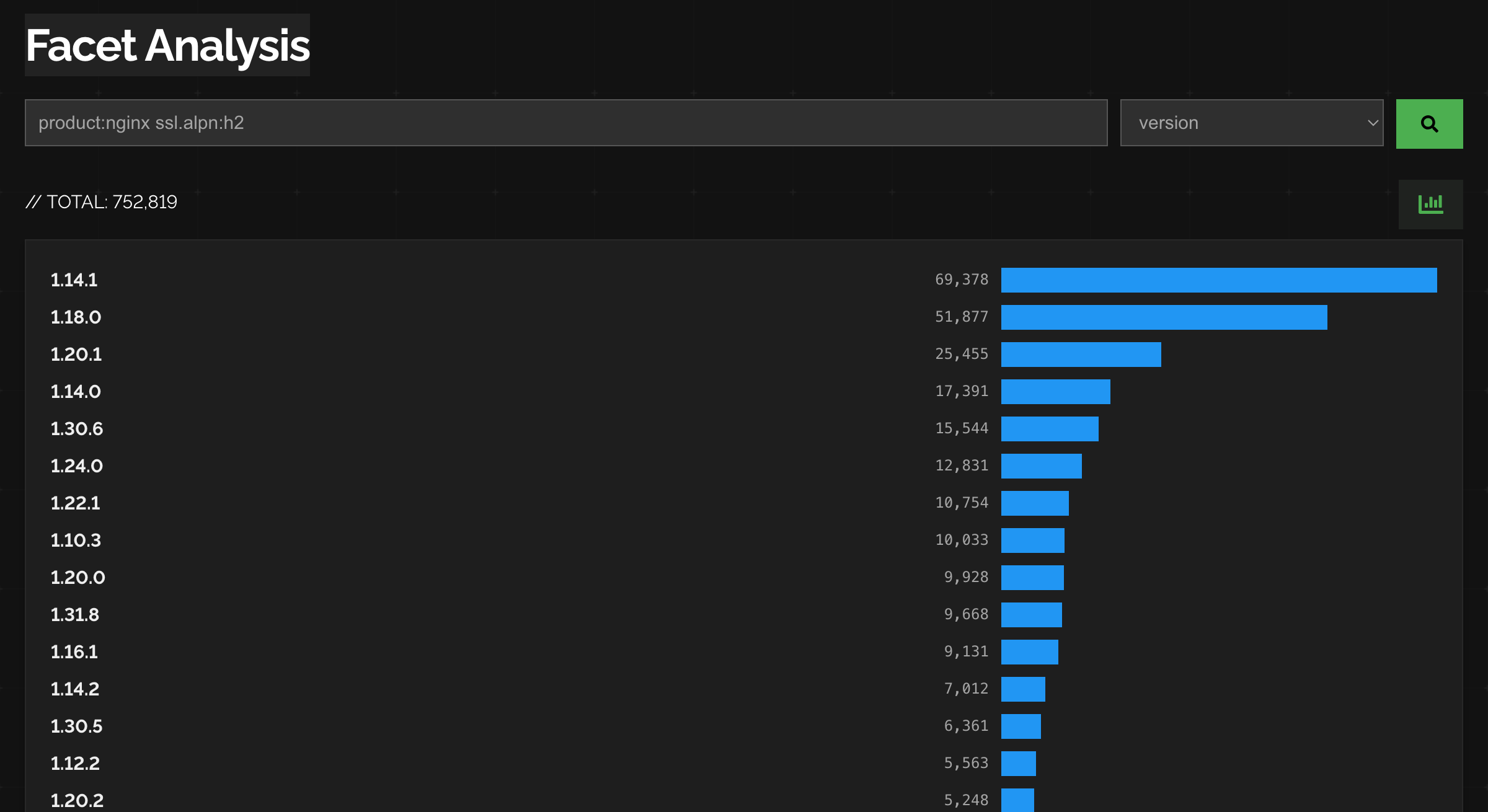
Shodan sees 752,819 of those servers offering HTTP/2 during the TLS handshake. That is a floor, not a census: Shodan records the negotiated protocol for only part of the hosts it scans. The top of that list is 1.14.1 and 1.18.0, the versions that RHEL 8 and Ubuntu 20.04 ship.
Why most affected NGINX waits on a distribution fix
The advisory says upgrade to 1.30.7 or 1.31.9. That advice fits a minority of real servers. Most NGINX is installed from the operating system's package manager or baked into a container base image, and those builds get fixed when the distribution backports the patch, under the same version number.
The version banners show how wide that gap is. Shodan lists a version for about 12.9 million NGINX servers in its top 100 versions, and 99% of them fall inside the affected range. Of those, only 10% run 1.30 or 1.31, where an upgrade to 1.30.7 or 1.31.9 is a routine update. 64% run one of six versions that distributions ship by default: 1.24.0 (Ubuntu 24.04), 1.18.0 (Ubuntu 20.04 and Debian 11), 1.22.1 (Debian 12), 1.20.1 (RHEL 9), 1.26.3 (Debian 13) and 1.14.1 (RHEL 8). The other 26% run older upstream lines that nginx.org will not fix, where the only fix is a jump to a supported line.
A banner shows the upstream version, not the distribution build, so a backported fix will not change what scanners see. That makes the distribution's tracker, not the banner, the source of truth for whether a server is fixed.
By November 19, Alpine, Ubuntu and Amazon Linux had shipped fixed packages. Debian has fixed only unstable, and Red Hat lists nginx on RHEL 8, 9 and 10 as affected with no fix yet. On Debian stable and the RHEL family, turning off HTTP/2 is the control you own until the package ships.
Are attackers exploiting NGINX2Shell?
As of 12:20 UTC on November 19, no vendor had reported exploitation in the wild, CISA's SSVC entry listed exploitation as none, and neither CVE was on the KEV list.
That window is closing. Rapid7 demonstrated unauthenticated code execution through CVE-2026-123007 with its own proof of concept against NGINX 1.31.8 in a lab. Its exploit needed about 128 GB of HTTP/2 traffic, which Rapid7 says limits attacks over the internet. Xint reports a separate Linux kernel bug that can be chained with these NGINX bugs to gain root on the host. GitHub repositories that describe themselves as proof-of-concept code have appeared too. We have not run any of them, and some of these repositories turn out to be fake or malicious. Treat internet-facing HTTP/2 endpoints as targets now.
How to check your NGINX servers
For a quick outside view, run any internet-facing hostname through our free NGINX2Shell checker. It reads the NGINX version the server announces and tells you which fix applies. It cannot see whether HTTP/2 is on or whether your distribution backported the fix, and a server that hides its version gets no verdict, so confirm on the host with the commands below.
Find the version. Run this on the host or inside the container:
nginx -v 2>&1Versions 1.9.5 through 1.30.6 and 1.31.0 through 1.31.8 are affected. A distribution package may carry a backported fix under an affected version number, so check your distribution's tracker before you clear it.
Then check whether HTTP/2 is on. This prints every line of the loaded configuration that enables it:
nginx -T 2>/dev/null | grep -nE '^\s*(listen\s[^;]*\bhttp2\b|http2\s+on\s*;)'From outside, ask the server which protocol it negotiates over TLS. ALPN protocol: h2 means HTTP/2 is reachable. If a CDN or load balancer terminates TLS in front of NGINX, this checks that device, not NGINX:
echo | openssl s_client -connect example.com:443 -servername example.com -alpn h2 2>/dev/null | grep -i '^ALPN'Finally, look for crashes. Both bugs can kill a worker process, and NGINX logs every worker that dies on a signal. A burst of these lines on a server that used to run quietly deserves a look:
grep -E 'worker process [0-9]+ exited on signal (6|11)' /var/log/nginx/error.logA crash is not proof of an attack and an attack does not have to crash a worker, so treat a hit as a reason to patch first and investigate second.
How to fix NGINX2Shell
Move to NGINX 1.30.7 (stable) or 1.31.9 (mainline), or to your distribution's fixed package once it ships, then restart NGINX so no old worker keeps running. NGINX Plus users need 37.0.8.1 or 37.3.0.1 for CVE-2026-123007 and 37.0.7.1 or 37.2.0.1 for CVE-2026-123633, per Wiz's table. Images that bundle NGINX need a rebuild, and the rebuild only helps once the base image ships a fixed NGINX.
Patch in this order:
- Internet-facing NGINX that terminates HTTP/2 itself, with no CDN or WAF in front.
- NGINX reverse proxies, where CVE-2026-123633 is more reachable.
- Everything else on an affected version, including internal services.
Workaround if you cannot upgrade yet
Turn off HTTP/2. Remove the http2 parameter from every listen directive, and on NGINX 1.25.1 or later also set http2 off; in the http block:
http {
    http2 off;

    server {
        listen 443 ssl;
        # was: listen 443 ssl http2;
    }
}
Then test the configuration and reload:
nginx -t && nginx -s reloadBrowsers fall back to HTTP/1.1 and keep working. Clients that need HTTP/2 end to end, such as gRPC services, stop working, so check what talks to the server before you switch it off. Run the alpn check again after the reload: no ALPN protocol: h2 line means the workaround took effect. Keep it only until the fixed build is in place.
How ZEST handles NGINX2Shell
Scanners had not caught up on the day NGINX shipped the fix, and NVD had not analyzed either CVE. ZEST did not wait for them. Within hours of the release, ZEST:
- matched every NGINX package its connected inventories report against the exact range of each CVE, per release line, and separated upstream builds that can upgrade now from distribution builds that wait for a backport and old lines that will never be fixed;
- created a vulnerability, flagged as a zero-day, on every affected system that no scanner had reported yet, with the fix or workaround that applies to that exact build;
- opened a live campaign for each affected environment that tracks every one of those systems until it is fixed, and picks up scanner detections as they arrive;
- validated which systems it could not see, such as disconnected accounts and stale integrations, so a quiet result is never mistaken for a safe one.
Anyone can check a public hostname with our free NGINX2Shell checker. We ran the same playbook for Java4Shell, HTTP2Shell and PHP2Shell.
NGINX2Shell FAQ
Is NGINX without HTTP/2 affected?
Not by these two bugs. Both need HTTP/2. The same release fixes other bugs, including an HTTP/3 use-after-free, so upgrade anyway.
Does a CDN or WAF in front of NGINX protect me?
It may block parts of the attack when it terminates HTTP/2 itself, Wiz says. It does not fix NGINX, and any path that reaches NGINX directly stays exposed.
Are Kubernetes ingress controllers affected?
Anything that bundles an affected NGINX with HTTP/2 enabled is. The community ingress-nginx project is archived and has published no fixed image, so check with whoever builds the controller you run.
Is it exploited in the wild?
Not as of 12:20 UTC on November 19. Rapid7 has shown code execution in a lab, so plan as if it will be.
Sources
- nginx.org security advisories
- nginx CHANGES, 1.31.9
- NVD: CVE-2026-123007
- NVD: CVE-2026-123633
- Wiz Research: NGINX HTTP/2 RCE vulnerabilities
- Ubuntu: CVE-2026-123007
- Debian security tracker: CVE-2026-123007
- Amazon Linux security center: CVE-2026-123007
- Shodan: NGINX by version
- Shodan: NGINX versions offering HTTP/2
About The Author